
We're glad to report that our CANine USB-to-CAN adapters are back in stock!
We've updated the CANine adapter PCB design, which is now fully compatible with USB-C cables. To address the semiconductor shortage, we exchanged a few components on the board for more readily available ones; some of the shipped boards will include these new components. In any case, all newly shipped CANine boards are functionally identical.
Up until now, Tinymovr development was carried out using the Qorvo-supplied, Eclipse-based development environment. While this solution supports all necessary functionalities, it comes with a few drawbacks. The most important is that it is only supported on Windows, so our Linux or MacOS-based users may have a hard time adapting the firmware to their needs. To improve this we set out on an effort to create a build and debug environment to allow users to build and debug the Tinymovr firmware using GNU make. As a result of this, you can now clone the Tinymovr repo in any arm-embedded-gcc supported OS and build the firmware with a single make command. What’s more, we included configurations for VS Code Makefile tools and Cortex-debug, to enable building and debugging right from within VSCode!
Here's a VSCode screenshot during a debug session:
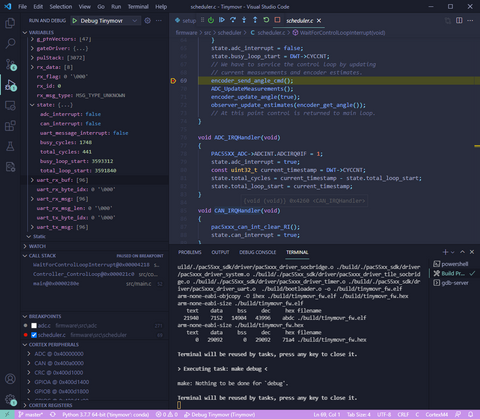
To experiment with the new setup you will need VSCode, a J-Link probe, and the latest Tinymovr firmware source from Github. More info can be found in the docs. While we were at it, we cleaned up a few issues and did some minor refactoring to simplify the code and make it more readable. If you are interested in a slightly more performant firmware, take a look at the releases.
On another note, we published an introduction video outlining the effects of inrush current on electronics, and how our PDB Dianome helps protect from it. Check it out below:
With the new year's upon us we'd like to take this chance to thank all of our users who have supported us through 2021, and helped improve our products through their feedback. We are working on numerous software and hardware updates for the coming period, and we'll be sharing more in future updates starting with the new year, so stay tuned!
Happy holidays, happy new year, and as always, stay safe!


